Operator models
PPA structures between operator and offtaker, five possible revenue models.
A power purchase agreement (PPA) is a long-term electricity supply contract between two parties: an operator and an offtaker. The operator invests in an energy asset, for example a PV system, a battery or both together, and builds it on the offtaker's property. The offtaker carries no investment cost of their own and buys the generated or battery-optimized power at a price agreed in advance.
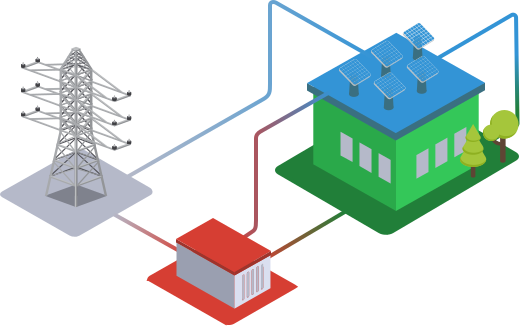
The parties involved
- The operator: finances, builds and runs the asset, carries the investment risk.
- The offtaker: benefits from falling electricity costs and grid fees (Netzentgelte) without investing. Depending on the contract model, they pass part of the savings on to the operator.
The operator's revenue sources
- Direct power sale: at the agreed PPA price per kWh, from the PV system or the battery. The operator earns the difference between procurement cost and PPA price.
- Share of the peak shaving: example: the battery reduces the grid fee by €20,000/year. At 50% for the operator, the operator receives €10,000/year and the offtaker saves €10,000/year as well.
- Feed-in tariff: for surplus power that is fed into the public grid.
- Share of the total savings: example: the asset saves €30,000/year in total. At 30% for the operator, the operator receives €9,000/year and the offtaker keeps €21,000/year. In this model the battery's charging costs are split proportionally as well.
- Rent payments: can be agreed in addition, are possible in both directions, and can be combined with any other model.
Separate PPA prices by power source
In the combined model (PV + battery) you can agree different PPA prices for direct PV power and battery power, because battery power is more flexible in time but comes with efficiency losses. An existing PV PPA can also be extended by an additional battery PPA.
Billing the battery power
If the operator sells power to the offtaker in the combined model, Furo asks "Bill battery PPA on" after the pricing question. The answer sets which quantity the battery PPA price applies to – with one shared PPA price as well as with separate prices:
- Delivered energy: billed is what the battery delivers to the load. The operator bears the efficiency losses.
- Charged energy: billed is the energy before efficiency losses, as some contracts specify. At 95 % efficiency per direction that is about 11 % more kWh than delivered.
With "Charged energy" the operator's electricity sales revenue and return rise, and the offtaker's savings fall by the same amount. The optimization accounts for the higher revenue and discharges the battery to the load slightly more often. Direct PV delivery is unchanged.
Which model fits when?
| Situation | Recommended model |
|---|---|
| Operator wants direct, predictable revenue per kWh delivered | Direct power sale (PPA price) |
| Site has high, reliably forecastable peak loads | Peak shaving |
| Operator and offtaker want a fair, result-based split | Share of the total savings |
| In addition to one of the models above | Rent payments |
Who gets what?
Who receives the feed-in tariff and who carries the grid import costs for charging the battery depends on the remuneration model and the system configuration.
PV and battery
| Remuneration model | PPA power sale | Share of total savings | Share of peak shaving |
|---|---|---|---|
| Feed-in tariff goes to | Operator | Operator | Operator |
| Grid import costs carried by | Operator | Offtaker | Operator |
Battery only
| Revenue model | PPA power sale | Share of total savings | Share of peak shaving |
|---|---|---|---|
| Feed-in tariff goes to | not possible | Offtaker | Offtaker |
| Grid import costs carried by | not possible | Offtaker | Offtaker |