Flexibility marketing
Market unused capacity on energy markets.
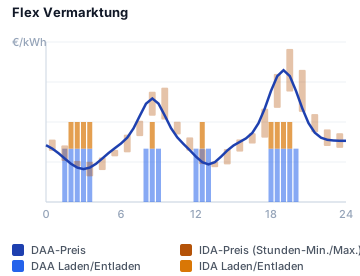
On top of the primary use case, the battery markets unused capacity on the energy markets. Self-consumption, peak shaving and procurement optimization stay unchanged: only the power and energy the battery still has free afterwards are marketed.
Example: 1,000 kWh battery, price difference of €100/MWh (€0.10/kWh) between cheap and expensive hours. With SOC headroom of 20 to 80% (600 kWh usable), one cycle yields around €60; if less headroom is left, say 40 to 60% (200 kWh), it is around €20.
Flexibility marketing can only be enabled from 150 kW of battery power upwards. Smaller storage systems can't be marketed sensibly, which is why the option is not selectable below that.
At present no EMS (energy management system) executes flexibility marketing automatically in real time. The figures in Furo show the economic potential, not a running automatic execution.
Automated real-time marketing of this capacity is the vision behind Furo Flex and is being rolled out via the virtual battery.
Two models for flex revenue
Under "How should flex revenue be modelled?" you choose how Furo estimates the revenue:
| Marketer Flat Rate | DAA & IDA Simulation | |
|---|---|---|
| How Furo calculates it | your flat rate in € per MW and year times the average free battery power | trading on the day-ahead market (DAA) and the intraday market (IDA1) with the real quarter-hour prices from the period of your load profile |
| Free power | rated power minus the power used for your own demand, at most what the grid connection can still take or deliver; zero in peak-load time windows (atypical grid usage) | as left, plus at most 730 full cycles per year for the whole battery |
| New peaks caused by trading | not considered | cost demand charge and are included; under AgNes the peak costs nothing, and the load-peak protection there offers "Hard (cap)" against "Off" |
| Countries | all | Germany only |
Flex marketing assumptions:
- The first-year flex revenue applies unchanged to every year of the lifetime.
- The DAA & IDA Simulation shows the market revenue before your marketer's share and calculates trading without efficiency losses.
- Traded power pays no grid fees, levies or electricity tax there, because Furo applies the exemption under § 118 (6) EnWG for the whole lifetime. The exemption lasts 20 years for storage commissioned by August 2029; how storage commissioned later will be treated is still open from a regulatory point of view.
- Under AgNes traded power additionally pays no grid working price: the AgNes draft frees the quantities a plant-coupled storage draws from and feeds back into the grid from the working prices, "soweit eine Abgrenzung dieser Mengen messtechnisch möglich ist" — as far as those quantities can be told apart by metering (Tenor 10.2 sentence 3). Furo assumes that metering concept is in place. Without it, the energy above the booked capacity would be billed at working price 2; Furo does not model that, so the flex revenue would come out too high.
- Balancing power (FCR, aFRR) is included in neither model.
- The flex revenue assumes the battery charges from and discharges into the grid, even if you turn on "Green Energy Storage" or set "Allow battery feed-in" to No. The form points out this combination.