Plan
Sizing battery storage: from the raw data to a customer-ready report.
With Plan you size your battery storage. You upload your consumption data and your site, and Furo calculates the optimal storage size from it, checks the economics and produces customer-ready documents.
Open in Furo: app.furoenergy.com/new-project
Default economic assumptions: Without your own figures, Furo calculates with a 15-year project term and a 2% discount rate per year, both overridable under "Project Specific Settings". How net present value and payback period come out of that is described under Economics.
The process
Record the data
Under Available Data you record what you have: whether a PV system exists, whether your load profile (Lastgang) comes as Total Consumption (Gross), Grid Consumption (Net) or Full feed-in, and whether an operator model (PPA) is in place. Then you upload your load profile as CSV or Excel. Without a load profile of your own, you pick a standard load profile from the Load Library and enter only the annual consumption. Upload Invoice (BETA) transfers tariff data straight from an electricity bill.
Everything you need to collect for this is listed in the data collection sheet, which is also available there as a one-page PDF to pass on to customers.
PV & battery
Create your PV systems (peak power, orientation, feed-in tariff model, commissioning year). Under Battery Analysis Type you decide how Furo calculates: compute the Optimal Battery, simulate a Portfolio Battery, or put several models up against the optimal battery in the Portfolio Battery Comparison. In the battery selection you draw on one or up to ten batteries from the battery portfolio, depending on the analysis type, optionally with a Maximum Investment.
Tariff & grid fees
Enter the electricity price and the grid fees (Netzentgelte), including the demand charge (Leistungspreis). Furo takes the 2,500-hour rule (2.500-Stunden-Regel, § 19 StromNEV), atypical grid usage (atypische Netznutzung) and variable grid fees into account; they can be pre-filled automatically from the address. With the IST/SOLL Comparison you put the current and the target state side by side. All tariff models are described under Electricity prices and grid fees.
EV charging (optional)
Under EV you model the charging load of vehicles: fleet charging by distance driven, or public charging by arrivals. Furo simulates the weekly charging load and adds it to your load profile.
Look at the results
Under Our Recommendation Furo shows the most economical option with Net Present Value and Payback Time, plus all options as a table and a heatmap. Charts such as Savings Breakdown per Year, Energy Flow Diagram and Accumulated Cash Flow make the result traceable. How these key figures come about is described under Economics.
Data export
Export the results as a shareable, branded link, as CSV, as PDF or as a PowerPoint report (Enterprise).
How Furo calculates
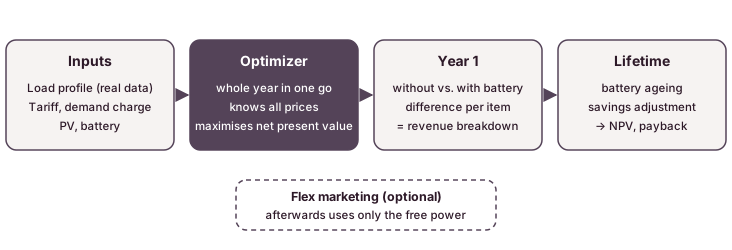
Furo plans battery operation for your whole load profile in a single run. The battery only charges grid power when it pays off: when the feed-in tariff after efficiency losses is above the purchase price, it does not charge from the grid in that hour.
The goal is the highest net present value over the project lifetime, not the highest utilization. The optimizer chooses the operating strategy on that basis and, for Optimal Battery, also the size. Ageing per cycle counts as a cost, so the battery only runs cycles that pay off. Few full cycles do not mean potential is wasted; they mean additional cycles would earn less than the ageing they cause.
How the individual euro amounts follow from the result is described under Economics.
Perfect foresight: The optimizer knows load, PV generation and prices for the whole year in advance. The result therefore shows the battery's economic potential. In live operation Furo works with forecasts and approaches this potential.
Feature deep dive
Project overview
Managing projects: list, Kanban board, filters and stages.
Load profile
Load profile type, file format and standard load profiles.
PV & remuneration
System data, feed-in tariff models and the market premium.
Battery design & selection
Which storage Furo calculates and how you compare models.
Electricity prices and grid fees
The four tariff models and the price entry.
EV charging
Simulating the charging load of vehicles.
Economics
Recalculating net present value, payback and debt.
Data Assistant (BETA)
Chat a clean load profile out of raw files.
Battery portfolio
Your reusable battery catalog.
Share analysis
Pass on results by link or as a copy.