PV & remuneration
What you enter per PV system, which feed-in tariff models there are and how the market premium comes about.
Under General Information you create every PV system alongside the company data and the load profile. Which profiles belong with it is described under Load profile.
Your PV systems
For each PV system you enter:
- Peak power and orientation (azimuth and tilt; for east-west systems several orientations are possible).
- The commissioning year, which determines the EEG (Renewable Energy Sources Act) rule at negative electricity prices.
- The Feed-in Tariff Model: feed-in tariff, market premium or direct marketing (Direktvermarktung), meaning selling PV power on the market through a Direktvermarkter.
- The toggle "Allow battery feed-in", which controls whether the battery itself may feed into the grid.
Feed-in tariff models
| Model | What you enter | What you get per kWh fed in |
|---|---|---|
| Fixed Feed-in Tariff | EEG remuneration in €/kWh | the fixed rate; at negative electricity prices €0/kWh (Solarspitzengesetz) |
| EEG Sliding Market Premium | applicable value (anzulegender Wert) in €/kWh | the spot price of the quarter-hour plus the market premium |
| Direct Marketing without EEG | — | the spot price of the quarter-hour |
The market premium is the applicable value minus the solar market value (Marktwert Solar) of the settlement period, at least 0. The solar market value is a nationwide, generation-weighted average (in Austria the monthly reference market value from E-Control) — it does not depend on when you feed in. The premium is therefore a constant add-on per kWh, and the storage changes only the spot share of your revenue.
In the results you'll find the ⌀ feed-in price after battery: the price the optimization achieved on average. With the market premium and direct marketing it is regularly above your applicable value, because the battery shifts the feed-in into expensive hours. With a fixed tariff it can be below it instead: because of the Solarspitzengesetz nothing is remunerated at negative electricity prices, and that lowers the annual average. Your direct marketer's fee is in no case deducted — record it if needed as a negative amount under "Additional costs" in the field "Additional revenue or costs".
Alongside it you'll find the ⌀ feed-in price before battery: the same average for the PV system alone. The difference between the two figures is the storage's contribution — and the value you can hold against your direct marketer's statement. With the market premium the premium is identical in both figures, because it does not depend on the time of feed-in; only the spot share can be shifted.
MiSpeL: feed-in from the battery
If the battery also charges grid power, the power it feeds in is only partly green power. For this, Furo uses the allocation option (Abgrenzungsoption) under MiSpeL in Germany. First, Furo determines the battery's green-power share over the whole year: PV charging divided by total charging. Then:
- Direct PV feed-in earns the full remuneration.
- With the market premium, feed-in from the battery earns the spot price, but the market premium only for the green-power share. With a fixed feed-in tariff, only the green-power share is remunerated.
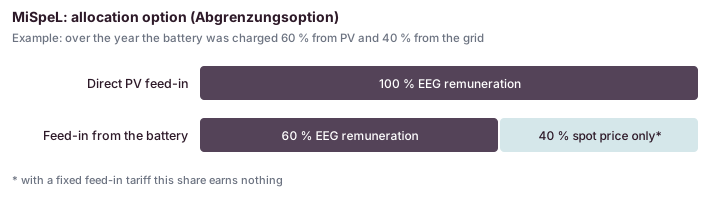
If the battery charges only PV power, the share is 100 % and nothing is reduced. Background, blog articles and webinars are in the MiSpeL knowledge package.
MiSpeL assumptions: Furo uses one green-power share for the whole year, not per quarter hour. Furo plans the operation with the full remuneration and applies the split to the revenue afterwards. Furo does not model the exclusivity option (Ausschließlichkeitsoption).